

Choosing the best swimming pool dehumidifier in UAE and GCC countries requires careful consideration of extreme summer temperatures, coastal humidity, pool size, and installation requirements. In Dubai, Abu Dhabi, Sharjah, Saudi Arabia, Oman, Qatar, Kuwait, and Bahrain, outdoor relative humidity can exceed 80%–90% during humid summer periods. Indoor swimming pools in luxury villas, hotels, sports clubs, public swimming facilities, and spas generate substantial moisture through continuous water evaporation. Without a properly designed indoor swimming pool dehumidification system, excess humidity can cause condensation on glass windows, mold growth, structural deterioration, and corrosion of HVAC equipment from chloramine exposure. Standard air conditioning primarily controls temperature and may not adequately manage pool evaporation loads, making dedicated refrigerant-based pool dehumidifiers with corrosion-resistant coils an effective solution.
The best pool dehumidifier depends on swimming pool surface area, water temperature, room temperature, bather activity, ventilation requirements, and architectural design. Ducted swimming pool dehumidifiers installed in mechanical rooms are ideal for luxury villas, hotels, and commercial pools requiring quiet operation, concealed equipment, and uniform dry-air distribution along windows. Ceiling-mounted or inline pool dehumidifiers suit smaller residential pools, indoor jacuzzis, and home spas where floor space is limited. Wall-mounted swimming pool dehumidifiers offer practical solutions for existing pools and renovations where duct installation is difficult. Portable or floor-standing dehumidifiers are generally better suited to temporary moisture control, provided they are safe and suitable for the pool environment. Large public, Olympic, and sports club pools may require central pool dehumidification systems, high-capacity air handling units, fresh-air integration, and BMS automation.
An efficient commercial or industrial swimming pool dehumidifier should incorporate corrosion-resistant evaporator and condenser coils, automatic humidistat control, condensate drainage, and energy-saving hot gas reheat technology. Some advanced systems also recover heat for swimming pool water heating. Indoor pool humidity is commonly maintained at 50%–60% RH, while room air temperature is often kept approximately 1°C–2°C above pool water temperature to reduce evaporation. Proper dehumidifier capacity should be calculated using an appropriate ASHRAE natatorium evaporation methodology, considering water surface area, activity factor, operating conditions, outdoor humidity, and fresh-air moisture loads.
Control Technologies FZE (CtrlTech) supplies wall-mounted, ceiling-mounted, ducted, and central swimming pool dehumidifiers for residential villas, hotels, spas, and commercial swimming pools throughout Dubai, Abu Dhabi, Sharjah, UAE, Saudi Arabia, Oman, Qatar, Kuwait, and Bahrain. Contact CtrlTech for professional humidity-load calculations, equipment selection, installation, commissioning, and maintenance of customized pool dehumidification solutions.
Why Pool Humidity Control Matters More in the Gulf
Every indoor pool generates moisture. Warm water evaporates continuously, releasing thousands of liters of water vapor into the air daily. In temperate climates, this is manageable. In the Gulf region, it becomes critical.
Here’s the problem: Gulf coastal environments already carry high humidity levels and corrosive salt particles. Add an indoor pool, and you create conditions where:
- Structural damage accelerates. Moisture penetrates concrete, causes rebar corrosion, and degrades building materials.
- Metal fixtures corrode rapidly. HVAC components, lighting, railings, and ceiling supports rust within 12-18 months without protection.
- Mold growth becomes inevitable. Warm, humid pool rooms provide ideal conditions for mold and mildew.
- Guest comfort drops. Sticky, muggy air makes the pool area unpleasant despite climate control efforts.
- Energy costs spike. Air conditioning systems work overtime trying to manage moisture they weren’t designed to handle.
The ASHRAE standard recommends maintaining indoor pool areas at 50-60% relative humidity. In Gulf facilities, achieving this requires purpose-built swimming pool dehumidification systems: not standard HVAC equipment.
Types of Swimming Pool Dehumidifiers Compared
Not all dehumidifiers work equally well in pool environments. Here’s how the main technologies compare for Gulf climate applications.

Condensing (Refrigerant) Dehumidifiers
Condensing dehumidifiers pull humid air across cold coils, causing moisture to condense and drain away. These units work best in warm environments, making them ideal for Gulf pool rooms.
Advantages:
- High efficiency at temperatures above 20°C
- Heat recovery capability: recovered heat can warm pool water or room air
- Lower operating costs compared to desiccant systems in warm climates
- Proven technology with reliable performance
Best for: Hotels, fitness centers, residential villas, and commercial pools in Dubai, Abu Dhabi, and across the UAE.
Desiccant Dehumidifiers
Desiccant systems use moisture-absorbing materials rather than refrigeration. They excel in cold storage and low-temperature applications but offer less efficiency in warm pool environments.
Advantages:
- Effective at low temperatures
- Can achieve very low humidity levels
Limitations for pools: Higher energy consumption in warm climates. Generally not the first choice for Gulf pool applications unless combined with cooling requirements.
Ducted/Central Pool Dehumidification Systems
For commercial pools, hotels, and large residential properties, ducted systems provide the most effective solution. These units integrate with your HVAC infrastructure, distributing dehumidified air evenly throughout the pool hall.
Advantages:
- Uniform humidity control across large spaces
- Hidden installation: no visible equipment in pool area
- Quieter operation
- Centralized maintenance
- Better integration with building management systems
Ducted commercial dehumidifiers represent the professional standard for indoor pools in the UAE and GCC. They handle the continuous moisture load that pool environments generate while maintaining aesthetic appeal.
Key Features for Gulf Climate Pool Dehumidifiers
When comparing swimming pool dehumidifiers for UAE, Saudi Arabia, or other Gulf markets, prioritize these features:
Corrosion-Resistant Construction
This is non-negotiable for coastal Gulf environments. Look for:
- Epoxy-coated coils or copper/aluminum construction rated for saltwater environments
- Stainless steel drain pans and internal components
- Powder-coated or marine-grade cabinets
- Corrosion-resistant fan assemblies
Standard dehumidifiers will fail within 2-3 years in Gulf coastal pool rooms. Corrosion-protected units last 10-15 years with proper maintenance.

Heat Recovery Capability
Pool dehumidifiers remove moisture by cooling air below its dew point. This process generates heat. Smart systems recover this heat and use it productively:
- Pool water heating – Recovered heat maintains comfortable water temperature
- Space heating – Useful during cooler winter months
- Energy offset – Reduces overall facility energy consumption by 20-40%
Heat recovery transforms the dehumidification process from a pure energy cost into a partial energy benefit.
Capacity for Continuous Operation
Gulf pools operate year-round. Your dehumidifier must handle:
- 24/7 operation without overheating or cycling issues
- Peak loads during high-usage periods
- Elevated ambient temperatures (pool rooms can exceed 30°C)
Industrial-grade components and oversized condensers ensure reliable continuous operation in demanding Gulf conditions.
Humidity Control Precision
Effective pool room dehumidifiers maintain humidity within a tight range. Look for:
- Digital humidistat controls with ±2% accuracy
- Programmable setpoints for different times/seasons
- BMS integration for centralized building control
- Remote monitoring capabilities
Maintaining 50-60% RH consistently prevents both the problems of excess humidity and the discomfort of over-dried air.
Sizing Your Pool Dehumidifier Correctly
Undersized equipment runs continuously without achieving target humidity. Oversized equipment cycles excessively, wasting energy and causing humidity swings. Correct sizing matters.
Pool dehumidifier capacity depends on:
| Factor | Impact on Sizing |
|---|---|
| Pool surface area | Larger pools evaporate more water |
| Water temperature | Warmer water = higher evaporation rate |
| Air temperature | Differential between water and air affects evaporation |
| Room volume | Larger spaces require more air circulation |
| Activity level | Swimmers increase evaporation significantly |
| Ventilation rate | Fresh air introduces additional moisture load |
For Gulf climates, add 15-20% capacity buffer to account for extreme ambient conditions and occasional high humidity events.
A professional dehumidifier supplier in UAE can perform detailed calculations based on your specific facility. At CtrlTech, we provide free site assessments and capacity calculations for commercial pool projects across Dubai, Abu Dhabi, Sharjah, and the wider GCC region.
For guidance on humidity calculations, see our detailed guide on how to do dehumidifier calculations.
Ducted Central Systems vs. Portable Units
For most commercial indoor pools, ducted central dehumidification systems deliver superior results. Here’s the comparison:
Ducted/Central Systems
- Best for: Hotels, fitness centers, aquatic facilities, large residential pools
- Installation: Integrated with HVAC ductwork, typically in plant room
- Aesthetics: Completely hidden from pool area
- Performance: Even humidity distribution, consistent results
- Maintenance: Centralized access, easier servicing
- Cost: Higher initial investment, lower lifetime cost
Portable Units
- Best for: Temporary installations, small pools, backup capacity
- Installation: Placed directly in pool room
- Aesthetics: Visible equipment
- Performance: May create humidity variations across space
- Maintenance: Direct access but exposed to corrosive environment
- Cost: Lower initial cost, potentially higher operating/replacement costs
For permanent commercial installations in the Gulf, we recommend ducted central systems. The indoor pool dehumidifier range from CtrlTech includes ducted options specifically configured for pool hall applications.

The Corrosion Factor: Why It’s Critical in Gulf Coastal Areas
Dubai, Abu Dhabi, Doha, Jeddah: major Gulf cities sit on coastlines where salt-laden air penetrates every building. Pool rooms compound this challenge by adding chlorine compounds and constant moisture.
Standard dehumidifiers fail in these conditions. We’ve seen equipment require replacement after just 18 months in Gulf coastal pool installations. The cost of premature failure: equipment replacement, downtime, water damage from uncontrolled humidity: far exceeds the premium for corrosion-protected units.
When evaluating pool dehumidifier price in UAE, factor in:
- Expected lifespan (corrosion-protected vs. standard)
- Warranty coverage for coastal/pool applications
- Replacement parts availability locally
- Service support from a UAE-based supplier
The best dehumidifier for your pool isn’t necessarily the cheapest upfront. It’s the one that delivers reliable humidity control for 10+ years in Gulf conditions.
Related Applications
Pool dehumidification technology applies to similar humid environments. If you operate facilities with comparable challenges, the same principles apply:
- Spa and wellness centers – Similar humidity loads with added considerations for treatment rooms. Learn more about dehumidifiers for spas.
- Gym and fitness facilities – High occupancy creates significant moisture loads, especially in changing rooms.
Choosing the Right Dehumidifier Supplier in Dubai and UAE
Selecting equipment is half the equation. Selecting the right supplier determines your long-term success.
Look for a dehumidifier supplier in UAE that offers:
- Gulf climate experience – Understanding of local conditions and challenges
- Site assessment services – Proper sizing based on your specific facility
- Multiple brand options – Ability to recommend the best fit, not just one product line
- Local inventory – Fast availability without international shipping delays
- Installation support – Technical guidance for contractors and integrators
- After-sales service – Local maintenance and parts support
CtrlTech has supplied swimming pool dehumidification systems across the UAE and GCC for over a decade. Our team understands what works in Gulf coastal environments and what fails.
Next Steps
Choosing the best swimming pool dehumidifier for your Gulf climate facility requires matching equipment capabilities to your specific conditions. Ducted central systems with corrosion protection, heat recovery, and proper sizing deliver the most reliable results for commercial installations.
Contact CtrlTech for a free consultation. We’ll assess your pool facility, calculate the correct capacity, and recommend equipment that will perform reliably in UAE and GCC conditions.
Browse our complete industrial dehumidifier range or call our Dubai office to discuss your pool humidity control requirements.
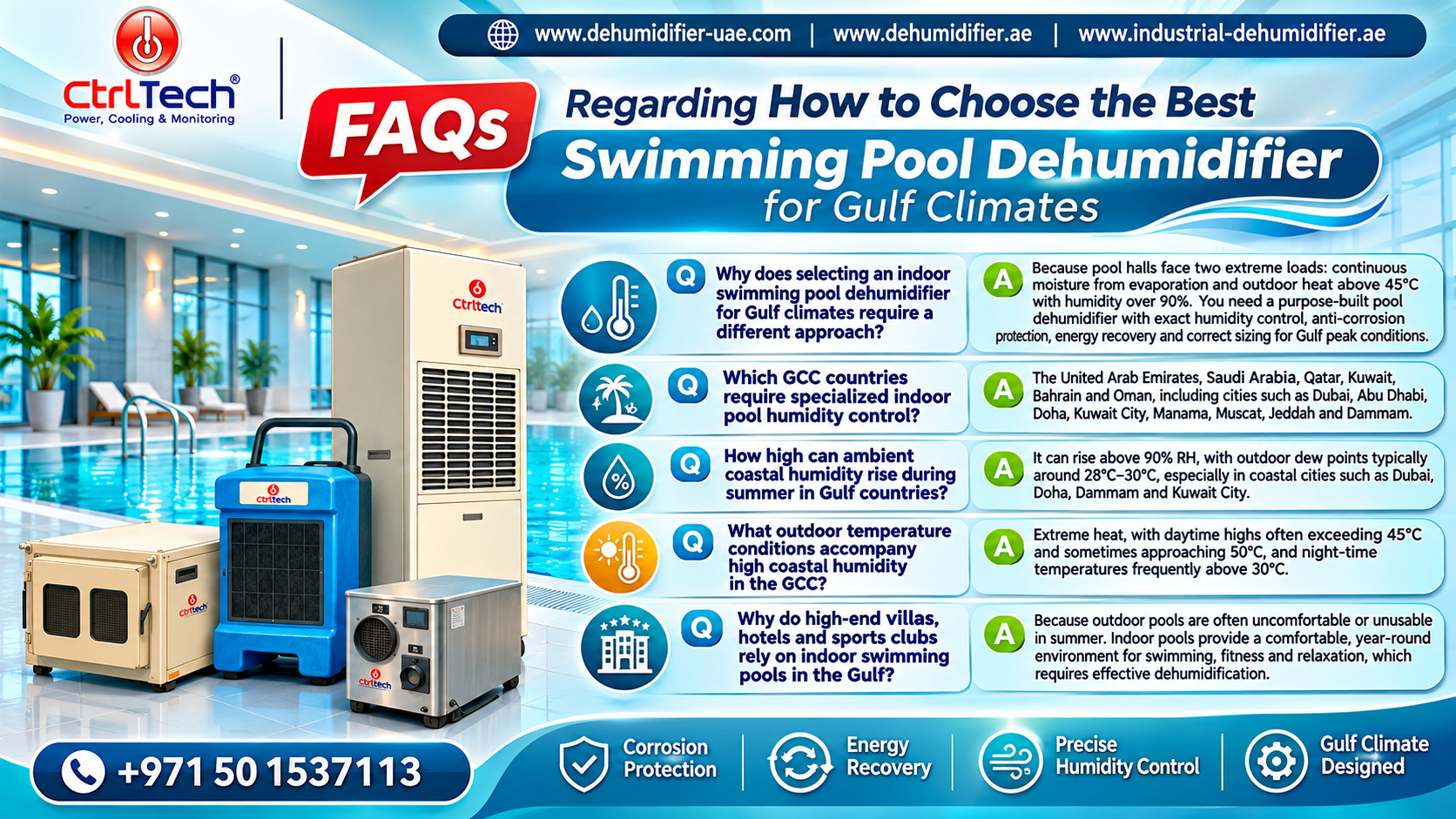
Frequently Asked Questions About Indoor Swimming Pool Dehumidification in Gulf Countries
Why does selecting an indoor swimming pool dehumidifier for Gulf climates require a different approach from standard HVAC design?
Selecting an indoor pool dehumidifier for Gulf climates requires a different approach because the pool hall faces two extreme loads at once. Inside, warm pool water evaporates continuously, releasing large amounts of moisture and corrosive chloramines into the air. Outside, summer temperatures exceed 45°C and coastal humidity can rise above 90%, so any fresh air or infiltration adds further heat and moisture. Standard HVAC is designed to control temperature, not this heavy latent load. Gulf natatoriums need purpose-built pool dehumidifiers with precise humidity control, anti-corrosion protection, energy recovery and correct sizing for local peak conditions to prevent condensation, mould and structural damage.
Which GCC countries are specifically mentioned as requiring specialized indoor pool humidity control?
The GCC countries mentioned as requiring specialised indoor pool humidity control are the United Arab Emirates, Saudi Arabia, Qatar, Kuwait, Bahrain and Oman. All six combine extreme summer heat with high coastal humidity, particularly in cities such as Dubai, Abu Dhabi, Doha, Kuwait City, Manama, Muscat, Jeddah and Dammam. Indoor pools in villas, hotels, sports clubs and residential towers across these countries face continuous evaporation from warm pool water alongside a harsh outdoor climate. As a result, they need dedicated pool dehumidification systems with corrosion-resistant construction and capacity sized for Gulf peak conditions, rather than relying on ordinary air conditioning. Coastal sites face the toughest conditions.
How high can ambient coastal humidity rise during summer in Gulf countries?
During summer, ambient coastal humidity in Gulf countries can rise above 90% relative humidity, especially at night and in the early morning, and can occasionally approach saturation with fog and heavy condensation. Outdoor dew points in coastal cities such as Dubai, Doha, Dammam and Kuwait City can reach 28°C–30°C, among the highest in the world. This matters for indoor pools because any fresh air, door opening or envelope leak brings this moisture inside, adding to the moisture already released by pool evaporation. Pool dehumidifiers in the Gulf must therefore be sized to handle both internal evaporation and these extreme external humidity conditions during peak months. Peak moisture usually occurs between July and September each year.
What outdoor temperature conditions accompany high coastal humidity in the GCC?
High coastal humidity in the GCC is accompanied by extreme outdoor temperatures, with summer daytime highs often exceeding 45°C and sometimes approaching 50°C in parts of the region. Night-time temperatures frequently remain above 30°C, so there is little relief from the heat. This combination of intense heat and high moisture creates one of the most demanding environments for HVAC equipment anywhere in the world. For indoor pools, it means outdoor air is both hot and wet, so fresh air must be carefully treated. Pool dehumidifiers and supporting cooling systems must be designed to cope with this combined heat and moisture load throughout the summer season. These conditions persist for several months, typically from June to September.
Why do high-end residential villas, hotels, and sports clubs in the Gulf rely on indoor swimming pools?
High-end residential villas, hotels and sports clubs in the Gulf rely on indoor swimming pools because outdoor pools become uncomfortable or even unusable for much of the summer. With air temperatures above 45°C, intense sunshine and high humidity, outdoor swimming can be unpleasant, and outdoor pool water may become too warm. Indoor pools provide a comfortable, controlled environment for year-round swimming, fitness, training and relaxation. They also offer privacy for residential owners, a premium amenity for hotel guests and a reliable training facility for clubs. Maintaining these benefits, however, depends on effective dehumidification to keep the enclosed pool hall comfortable and protected.
What type of indoor swimming pool environment is commonly used in high-end Gulf residential villas, hotels, and sports clubs?
High-end Gulf villas, hotels and sports clubs commonly use enclosed, climate-controlled indoor pool environments, often called natatoriums. These are fully enclosed pool halls with controlled air temperature, humidity and ventilation, typically featuring heated pool water, large glazed areas, decorative finishes and adjoining spa or wellness facilities. The enclosure protects swimmers from extreme outdoor heat and allows year-round use. However, because the pool continuously releases moisture and chloramines into a sealed space, these environments require dedicated dehumidification with careful air distribution, corrosion-resistant equipment and accurate humidity and temperature control to protect both occupants and the building.
Why do standard residential or commercial air conditioners fail to provide adequate humidity control in indoor swimming pool rooms?
Standard residential or commercial air conditioners fail in indoor pool rooms because they are controlled by temperature and designed mainly to remove heat. A pool hall has a very large, continuous moisture load from evaporating water, but its temperature may already be close to set point, so the AC cycles off while humidity keeps rising. Ordinary air conditioners also overcool the space if forced to dehumidify, making swimmers uncomfortable and increasing evaporation. In addition, their uncoated coils corrode quickly in chloramine-laden pool air. The result is high humidity, condensation, mould and equipment failure, which is why dedicated pool dehumidifiers are required. Purpose-built units handle moisture and heat separately and reliably.
What parameter primarily controls standard residential and commercial air conditioners?
Standard residential and commercial air conditioners are primarily controlled by air temperature, measured by a thermostat. The compressor runs when the room is warmer than the set point and stops once that temperature is reached. Humidity is not directly measured or controlled, so moisture removal happens only incidentally while the unit is cooling. In an indoor swimming pool room, this is a serious limitation, because the main challenge is moisture rather than heat. The pool continues to evaporate water even when the air temperature is satisfied, so humidity rises unchecked. Dedicated pool dehumidifiers solve this by using humidistat control that responds directly to moisture levels. This keeps the pool hall comfortable and dry.
What type of specialized dehumidification system does the document recommend for Gulf indoor swimming pools?
For Gulf indoor swimming pools, the recommended system is a specialised refrigerant-based (heat-pump) pool dehumidifier with energy recovery and heavy-duty anti-corrosion protection. These units cool pool hall air below its dew point to condense moisture, then use hot gas reheat to return warm, dry air to the room, so humidity is controlled without overcooling. Advanced models can also transfer recovered heat into the pool water. Coils and internal components are protected with coatings such as cataphoretic electro-coating to resist chloramine corrosion. Depending on the project, these systems are supplied as ducted plant-room, ceiling-concealed or wall-mounted units sized for Gulf peak conditions.
Why do indoor swimming pool dehumidification systems require heavy-duty anti-corrosion protection?
Indoor pool dehumidification systems require heavy-duty anti-corrosion protection because pool hall air is highly aggressive. Chlorine used to disinfect the water reacts with sweat, urine and other organic matter to form chloramines, which evaporate into the air along with moisture. When this warm, humid, chemical-laden air passes through a dehumidifier, it attacks copper tubes, aluminium fins, steel casings and electrical components. Without protection, coils can develop pinhole leaks and fins can disintegrate within a short period, causing refrigerant loss and system failure. Protective coatings, stainless or coated casings and corrosion-resistant materials are essential for long, reliable service life.
What building-related damage can aggressive chloramine corrosion cause in indoor swimming pool environments?
Aggressive chloramine corrosion can cause significant building damage in indoor pool environments. It attacks structural steel, roof trusses, ceiling hangers, suspension systems and metal fixings, potentially weakening them over time. It can corrode stainless steel fittings, handrails, ladders, light fittings, door hardware and ductwork. When combined with condensation, it can damage window frames, glazing systems, insulation and ceiling materials, and may contribute to concrete deterioration and reinforcement corrosion. Mould and staining can also develop on walls and ceilings. Controlling humidity, managing chloramines through proper ventilation and using corrosion-resistant materials help protect the building and avoid costly repairs.
What two environmental factors must Middle Eastern natatorium designs balance?
Middle Eastern natatorium designs must balance the intense internal moisture load from pool evaporation with the extreme external climate of heat and coastal humidity. Inside, warm pool water releases moisture and chloramines continuously, requiring dehumidification and ventilation. Outside, air temperatures above 45°C and humidity above 90% mean that bringing in fresh air for ventilation also adds heat and moisture. Designers must therefore control humidity and air quality inside the pool hall while limiting the cooling and dehumidification burden created by outdoor air. Achieving this balance requires correctly sized dehumidifiers, energy recovery, controlled fresh-air treatment and a well-sealed building envelope.
Which dehumidification technology is identified as the industry standard for Middle Eastern indoor swimming pool rooms?
Refrigerant-based dehumidification, often in the form of heat-pump pool dehumidifiers, is identified as the industry standard for Middle Eastern indoor swimming pool rooms. These systems cool pool hall air over an evaporator coil to condense moisture, then reheat the dried air using a hot gas reheat coil before returning it to the room. They operate efficiently at the warm, humid conditions typical of pool halls, recover the latent energy removed from the air, and can be fitted with anti-corrosion coatings to withstand chloramines. Advanced models can also transfer heat to the pool water, making refrigerant systems both effective and energy-efficient for Gulf natatoriums. This makes them the preferred choice for natatoriums across the GCC.
Why are refrigerant-based dehumidification systems recommended for Middle Eastern swimming pool applications?
Refrigerant-based systems are recommended because they perform best at the warm, humid conditions found in indoor pool halls, typically 28°C–32°C and 50%–60% RH. At these conditions, the evaporator coil removes large quantities of moisture efficiently. The heat released during condensation is recovered and used to reheat the dried air, and in advanced units to heat the pool water, reducing overall energy use. Refrigerant units do not need the high-temperature reactivation energy that desiccant systems require, and their coils can be protected against chloramine corrosion with coatings. This combination of efficiency, heat recovery and durability makes them the preferred choice for Gulf pools.
Why are desiccant wheel dehumidifiers described as inefficient at typical indoor swimming pool temperatures?
Desiccant wheel dehumidifiers are described as inefficient at typical indoor pool temperatures because their main advantage, removing moisture at low temperatures and low dew points, is not needed in a warm pool hall. At 28°C–32°C, refrigerant dehumidifiers already work very efficiently and recover useful heat. Desiccant units, by contrast, must constantly heat reactivation air to dry the wheel, consuming significant thermal energy and adding unwanted heat that the cooling system must then remove in a hot Gulf climate. Their desiccant material can also degrade when exposed to chlorine compounds. As a result, desiccant systems usually cost more to run and maintain in swimming pool applications.
What typical indoor pool room temperature range is mentioned when comparing refrigerant and desiccant systems?
The typical indoor pool room temperature range mentioned when comparing refrigerant and desiccant systems is around 28°C to 32°C. At these warm conditions, combined with relative humidity of about 50%–60%, refrigerant dehumidifiers operate at high efficiency because the air holds plenty of moisture that condenses readily on the evaporator coil. The heat recovered from condensation can be reused for air or water heating. Desiccant systems, which excel at cold temperatures and very low humidity, offer no real advantage in this range and consume additional energy for reactivation. This temperature range is therefore a key reason refrigerant systems are favoured for indoor pools. Typical pool halls in GCC villas and hotels fall within this range.
Why do desiccant dehumidifiers consume significant energy in indoor swimming pool applications?
Desiccant dehumidifiers consume significant energy in indoor pool applications because their desiccant wheel must be continuously dried, or regenerated, using a stream of heated reactivation air. Heating this air, often to well above 100°C, requires electric, gas or steam energy. In a pool hall, the moisture load is very high and continuous, so the reactivation heater runs for long periods. The process also adds heat to the dried air, which then increases the cooling load, a serious drawback in hot Gulf climates. Unlike refrigerant units, standard desiccant systems do not naturally recover latent heat for pool water or air heating, making them less energy-efficient for swimming pools. This raises total running costs.
What process requires thermal energy in a desiccant dehumidification system?
In a desiccant dehumidification system, the reactivation, or regeneration, process requires thermal energy. As the desiccant wheel rotates, one section absorbs moisture from the process air while another section passes through a separate stream of heated reactivation air. This hot air drives the absorbed moisture out of the desiccant, drying it so it can absorb moisture again. The moist reactivation air is then exhausted outdoors. Heating the reactivation air consumes considerable energy from electric heaters, gas burners or steam coils. In swimming pool applications, with a continuous heavy moisture load, this reactivation energy makes desiccant systems costly to operate compared with refrigerant units.
What happens to desiccant materials when exposed to airborne chlorine derivatives?
When exposed to airborne chlorine derivatives such as chloramines and other chlorine compounds, desiccant materials can degrade rapidly. These chemicals can react with or contaminate the desiccant surface, such as silica gel, blocking its pores and reducing its ability to absorb moisture. Over time, the wheel loses capacity, performance falls and humidity control becomes unreliable. The wheel may also suffer physical deterioration and require early replacement, which is expensive. Combined with high reactivation energy use, this vulnerability is a key reason desiccant systems are generally not recommended for indoor swimming pool halls, where chloramine-laden air is present continuously. Replacement wheels are costly.
Which airborne contaminants are identified as causing rapid degradation of desiccant materials?
The airborne contaminants identified as causing rapid degradation of desiccant materials are chlorine derivatives, mainly chloramines and other chlorine-based compounds released from swimming pool water. Chloramines form when chlorine disinfectant reacts with sweat, urine, body oils and cosmetics introduced by swimmers. These compounds evaporate into the pool hall air and pass through any dehumidifier. In a desiccant unit, they contaminate and attack the desiccant medium, reducing its moisture-absorbing capacity and shortening its service life. This is why refrigerant-based pool dehumidifiers with corrosion-resistant coatings are the preferred technology for indoor swimming pool environments in the Gulf region.
Why is anti-corrosion protection essential for swimming pool dehumidifiers in Gulf countries?
Anti-corrosion protection is essential because pool dehumidifiers in Gulf countries face a double threat. Inside, pool hall air carries moisture and vaporised chloramines that aggressively attack copper tubes, aluminium fins and steel components. Outside, coastal locations expose condensers, casings and fittings to salt-laden, humid air, while extreme heat accelerates chemical reactions. Without protection, coils can develop pinhole leaks, fins can crumble and casings can rust, leading to refrigerant loss, reduced capacity and premature failure. Protective coatings such as cataphoretic electro-coating, along with coated or stainless steel casings, greatly extend equipment life and maintain reliable performance.
What corrosive substances are present in indoor swimming pool air?
Indoor swimming pool air contains several corrosive substances. The most significant are chloramines, formed when chlorine disinfectant reacts with sweat, urine, body oils and cosmetics introduced by swimmers. Other chlorine compounds, including free chlorine and hypochlorous acid, can also evaporate from the water. Combined with the high moisture content of pool hall air, these chemicals create an aggressive, acidic environment. Where other treatment chemicals or salt chlorination systems are used, chlorides may also be present. These substances attack metal surfaces, HVAC coils, fixings and building structures, which is why pool dehumidifiers require specialised corrosion protection and proper ventilation.
Which standard HVAC coil materials are vulnerable to corrosion from vaporized chloramines?
Standard HVAC coils are typically made with copper tubes and aluminium fins, and both materials are vulnerable to corrosion from vaporised chloramines. Copper tubes can suffer pitting and pinhole leaks, leading to refrigerant loss and system failure. Aluminium fins can oxidise, become brittle and gradually disintegrate, reducing heat transfer and airflow. Joints, brazed connections and the bond between tubes and fins are also susceptible. In the warm, moist and chemically aggressive air of an indoor pool, uncoated coils can deteriorate far faster than in normal HVAC applications. Protective coatings, such as cataphoretic electro-coating, are therefore recommended for all pool dehumidifier coils.
What type of protective coating does the document recommend for swimming pool dehumidifier coils?
The document recommends cataphoretic electro-coating, often called e-coating, for swimming pool dehumidifier coils. In this process, the complete coil is immersed in a bath of epoxy-based coating and an electrical charge deposits a uniform, thin protective layer over every surface, including fins, tubes, bends and hard-to-reach areas. The coating is then cured to form a durable barrier against chloramines, moisture and other corrosive agents. Because it covers the coil evenly without significantly affecting heat transfer, e-coating offers strong protection with minimal performance loss. It is widely regarded as one of the most effective coil protection methods for indoor pool environments. It is now a common specification.
Which two examples of protective coil coatings are mentioned in the document?
The two examples of protective coil coatings mentioned are cataphoretic electro-coating, also known as e-coating, and specialised polyurethane-based coil coatings such as Blygold. Cataphoretic e-coating applies a uniform epoxy layer to the entire coil through an electrically charged immersion process, reaching every fin and tube surface. Polyurethane coatings like Blygold are typically spray-applied and provide a flexible, chemical-resistant barrier with good heat-transfer properties. Both are designed to shield copper and aluminium components from chloramines, moisture and salt air. Choosing a suitable coating for evaporator, condenser and reheat coils greatly extends the life of a pool dehumidifier.
Which dehumidifier coils should receive protective electro-coating?
All coils exposed to pool hall air should receive protective electro-coating. This includes the evaporator coil, which cools the air and condenses moisture; the hot gas reheat or condenser coil, which reheats the dried air; and any other air-side coils, such as heating coils or pre-cooling coils in the airstream. Where an air-cooled outdoor condenser is used, especially in coastal Gulf locations, its coil should also be protected against salt and humidity. Coating every exposed coil ensures that no single component becomes the weak point that fails early. Many pool dehumidifier specifications also require coated or stainless steel casings, drain pans and fan components. Comprehensive protection gives the longest service life.
What is the purpose of applying cataphoretic electro-coating to pool dehumidifier coils?
The purpose of applying cataphoretic electro-coating to pool dehumidifier coils is to create a complete, uniform barrier that protects copper tubes and aluminium fins from corrosion. In indoor pool halls, warm, moist air carrying chloramines attacks unprotected metals, causing pitting, pinhole leaks and fin deterioration. E-coating deposits an even epoxy layer over every surface of the coil, including edges and tight spaces that spray coatings may miss. This prevents corrosive agents from reaching the metal, maintains heat-transfer efficiency and greatly extends coil life. The result is fewer refrigerant leaks, more stable dehumidification performance and lower long-term maintenance and replacement costs.
What type of equipment failure can protective coil coatings help prevent?
Protective coil coatings help prevent premature coil failure caused by corrosion. Without coatings, chloramines and moisture can create pinhole leaks in copper tubes, resulting in refrigerant loss, reduced dehumidification capacity and eventual compressor damage. Aluminium fins may oxidise and crumble, blocking airflow and reducing heat transfer. Corroded coils can also contaminate condensate and lead to costly unplanned shutdowns. By shielding coil surfaces, coatings such as cataphoretic e-coating help avoid these failures, extend equipment life, maintain efficiency and reduce maintenance costs. In Gulf pool facilities, this protection is essential for keeping dehumidification systems running reliably year-round.
How do specialized swimming pool dehumidifiers remove moisture from indoor air?
Specialised swimming pool dehumidifiers remove moisture using a refrigeration cycle. A fan draws warm, humid pool hall air over a cold evaporator coil, which cools the air below its dew point. Water vapour condenses into liquid on the coil and drains away. The cool, dry air then passes over a hot gas reheat coil, which uses heat recovered from the refrigeration cycle to warm the air before it returns to the pool hall. This removes moisture without overcooling the room. Advanced units can also divert recovered heat to the pool water through a heat exchanger. Humidistat control ensures the dehumidifier runs according to moisture levels rather than temperature alone. This combination delivers efficient, comfortable humidity control for Gulf natatoriums.
To what temperature condition must pool room air be cooled for moisture extraction?
For moisture extraction, pool room air must be cooled below its dew point. The dew point is the temperature at which air becomes saturated and water vapour begins to condense into liquid. In a typical pool hall at around 30°C and 55%–60% RH, the dew point is roughly 20°C–21°C. The dehumidifier’s evaporator coil therefore operates well below this temperature, so moisture condenses on the coil surface and drains away. Once the moisture has been removed, the air is reheated by the hot gas reheat coil before returning to the pool hall. This allows effective dehumidification while maintaining the warm air temperature swimmers expect. Precise coil temperature control ensures consistent moisture removal throughout the day, even as swimmer numbers and pool hall conditions change.
What happens to rejected heat in swimming pool dehumidifiers equipped with energy recovery?
In swimming pool dehumidifiers equipped with energy recovery, the heat rejected by the refrigeration cycle is captured and reused rather than wasted. This heat includes the latent energy released when moisture condenses on the evaporator coil, plus the compressor’s energy. It is directed to a hot gas reheat coil to warm the dried air before it returns to the pool hall, preventing overcooling. In advanced models, part of this heat can also be transferred to the pool water through a dedicated heat exchanger, reducing pool heating costs. Any surplus heat may be rejected to an outdoor condenser when not needed. This energy recovery makes refrigerant pool dehumidifiers highly efficient. This lowers total energy costs.
What type of reheat coil is used in specialized pool dehumidification systems?
Specialised pool dehumidification systems use a hot gas reheat coil. This coil is positioned downstream of the evaporator coil and carries hot refrigerant gas discharged from the compressor. As the cool, dry air leaves the evaporator, it passes over the hot gas reheat coil and is warmed back to a comfortable supply temperature before entering the pool hall. Because the heat comes from the refrigeration cycle itself, no additional heater energy is needed for basic reheating. Like the evaporator, the hot gas reheat coil should be protected with anti-corrosion coating, such as cataphoretic e-coating, to withstand the chloramine-laden air found in indoor swimming pool environments. This keeps the coil reliable for years.
What is the function of a hot gas reheat coil in a swimming pool dehumidifier?
The function of a hot gas reheat coil in a swimming pool dehumidifier is to warm the air after moisture has been removed, using heat recovered from the refrigeration cycle. When pool hall air passes over the cold evaporator coil, it becomes cool and dry. Without reheating, this cold air would lower the pool hall temperature, making swimmers uncomfortable and increasing evaporation. The hot gas reheat coil uses hot refrigerant from the compressor to return the air to a suitable temperature before supply. This allows the dehumidifier to control humidity without overcooling, reduces the need for separate heating and improves overall energy efficiency in the natatorium. Comfortable, stable conditions are maintained throughout the day.
How does hot gas reheat convert latent energy into sensible heat?
Hot gas reheat converts latent energy into sensible heat through the refrigeration cycle. When moisture condenses on the evaporator coil, it releases latent heat, the energy held in water vapour, which is absorbed by the refrigerant. The compressor then raises the refrigerant’s pressure and temperature, adding its own energy. This hot refrigerant gas flows through the reheat coil, where it releases heat into the passing air, raising its temperature. In this way, energy that was hidden in the moisture of the pool hall air becomes measurable, sensible heat that warms the supply air. This recycling of energy is what makes refrigerant pool dehumidifiers so efficient compared with other technologies.
What type of air is returned to the pool room after hot gas reheating?
After hot gas reheating, warm, dry air is returned to the pool room. The air has first been cooled below its dew point on the evaporator coil, removing a significant amount of moisture, and then warmed by the hot gas reheat coil to a comfortable supply temperature, often slightly above the room temperature. Supplying this warm, dry air lowers the pool hall’s humidity while maintaining the warm conditions swimmers expect. In ducted systems, this air is typically directed along windows, glazing and exterior walls to prevent condensation on cold surfaces. The result is a comfortable, controlled environment that protects both occupants and the building structure. This keeps the pool hall comfortable, dry and free from condensation.
How does hot gas reheat help prevent overcooling of indoor swimming pool rooms?
Hot gas reheat helps prevent overcooling by warming the air after dehumidification. To remove moisture, the dehumidifier must cool pool hall air below its dew point, typically around 20°C. If this cold air were supplied directly, the pool hall temperature would drop, making swimmers feel chilly when leaving the water and increasing evaporation from the pool. The hot gas reheat coil uses recovered refrigerant heat to raise the supply air back to the desired temperature before it re-enters the room. This keeps the pool hall warm, typically around 30°C, while humidity is controlled. It also avoids the need for separate electric or water heaters for basic reheating. Swimmers stay comfortable while humidity remains within target.
How does hot gas reheat reduce the workload on the primary air conditioning system?
Hot gas reheat reduces the workload on the primary air conditioning system by allowing the dehumidifier to handle the pool hall’s moisture load independently, without relying on the AC to overcool and dehumidify. Because the dehumidifier supplies warm, dry air rather than cold air, the main air conditioning system does not need to run excessively to remove moisture, nor does a separate heater need to compensate for overcooling. The AC can then focus on managing sensible heat gains from sunlight, outdoor temperatures and occupants. This separation of latent and sensible loads results in more stable conditions, smaller cooling equipment, lower energy consumption and reduced wear on the primary system.
Can advanced commercial swimming pool dehumidifiers transfer recovered heat into pool water?
Yes. Advanced commercial swimming pool dehumidifiers can transfer recovered heat into the pool water. Using a dedicated water-cooled condenser or heat exchanger connected to the pool water circulation loop, the unit diverts part of the heat recovered from dehumidification and compression into the water instead of only reheating the air. This helps maintain pool water temperature and reduces the load on pool heaters or boilers, lowering energy costs. Control systems decide where heat is most needed, air, water or outdoor rejection, depending on conditions. In large hotel, club and public pools, this feature can deliver substantial savings while maintaining comfortable air and water temperatures.
Which component allows advanced pool dehumidifiers to transfer recovered heat to the swimming pool water loop?
A pool water heat exchanger, often called a pool water condenser, allows advanced pool dehumidifiers to transfer recovered heat to the swimming pool water loop. It is typically a titanium or cupro-nickel heat exchanger, chosen to resist corrosion from chlorinated or saltwater pool water. Hot refrigerant from the compressor passes through one side, while pool water from the filtration loop flows through the other, absorbing heat. This raises pool water temperature using energy recovered from dehumidification. The control system can direct heat to the water when the pool needs heating, to the air reheat coil when the room needs warming, or to an outdoor condenser when neither requires heat. This maximises energy recovery.
Which calculation method is identified for sizing swimming pool dehumidification systems?
The ASHRAE Natatorium Evaporation Formula is identified as the calculation method for sizing swimming pool dehumidification systems. Published in the ASHRAE Handbook, this widely recognised method estimates how much water evaporates from the pool surface, which forms the main moisture load the dehumidifier must remove. It considers the pool surface area, the difference between the saturation vapour pressure at the water temperature and the vapour pressure of the room air, and an activity factor reflecting how the pool is used. Air velocity over the water is also taken into account. Designers then add loads from fresh air and infiltration, plus a safety margin, to select the correct dehumidifier capacity.
What moisture-load quantity does the ASHRAE Natatorium Evaporation Formula calculate?
The ASHRAE Natatorium Evaporation Formula calculates the evaporation rate from the pool water surface, meaning the quantity of water that evaporates into the pool hall air over a given time. This evaporation rate represents the main internal moisture load in an indoor swimming pool and is the key figure used to size the dehumidifier. It depends on the pool surface area, the vapour pressure difference between the pool water and the room air, and the activity factor describing how actively the pool is used. The result is expressed in kilograms per hour. Designers then add other moisture sources, such as fresh air, infiltration and wet deck areas, to determine total dehumidification capacity. This gives a reliable basis for sizing.
In which unit is swimming pool moisture load expressed in the document?
In the document, swimming pool moisture load is expressed in kilograms per hour (kg/h), representing the mass of water evaporating from the pool into the room air every hour. Since one kilogram of water is approximately equal to one litre, this figure is often also expressed as litres per hour, and dehumidifier capacities may be quoted in litres per day by multiplying by 24. Using kg/h allows designers to match the calculated evaporation load directly with the moisture removal capacity of a pool dehumidifier at the specified room conditions. When selecting equipment, it is important to compare capacity ratings at actual pool hall conditions, typically around 30°C and 55%–60% RH. This ensures realistic, reliable equipment selection.
Which pool surface measurement is used in the evaporation calculation?
The evaporation calculation uses the pool water surface area, measured in square metres (m²). This is calculated from the length and width of the water surface, for example a 10 m by 5 m pool has a surface area of 50 m². Irregular pools are measured by their actual water surface footprint, and attached spas, jacuzzis or water features should be added separately, often with higher activity factors. Surface area is one of the most important inputs because evaporation occurs at the water surface, so a larger pool releases proportionally more moisture. Accurate measurements of the water surface are therefore essential for correctly sizing a pool dehumidification system. Spa and pool areas must be added together.
Which water temperature-related parameter is considered in the evaporation formula?
The evaporation formula considers the saturation vapour pressure of water at the pool water temperature. This value represents how strongly water molecules tend to escape from the pool surface into the air, and it increases rapidly as water temperature rises. For example, a pool kept at 28°C has a much higher saturation vapour pressure than one at 24°C, so it evaporates more water. The formula compares this value with the actual vapour pressure of the room air. The larger the difference, the greater the evaporation. This is why warm leisure pools, spas and hydrotherapy pools require more dehumidification capacity than cooler competition or training pools. Water temperature should therefore always be confirmed early in the design.
Which room air moisture parameter is considered in the evaporation formula?
The evaporation formula considers the partial vapour pressure of the room air, which is determined by the air’s temperature and relative humidity, or equivalently its dew point. This value shows how much water vapour is already present in the pool hall air. Evaporation is driven by the difference between the saturation vapour pressure at the pool water temperature and this room air vapour pressure. Keeping the air warmer than the water and maintaining relative humidity around 50%–60% helps control this difference, limiting evaporation. If the room air is too dry, the difference increases and the pool evaporates more water, raising the dehumidification load and energy consumption. Balanced conditions keep evaporation predictable.
What role does air velocity play in the document's swimming pool dehumidifier sizing methodology?
Air velocity plays an important role because moving air over the pool surface carries away water vapour and increases evaporation. The ASHRAE Natatorium Evaporation Formula assumes typical, gentle air movement over the water, generally around 0.05–0.15 m/s. If supply air is blown directly across the pool surface at higher speeds, evaporation increases and the actual moisture load exceeds the calculated value. Good design therefore directs supply air towards windows, walls and occupied deck areas rather than across the water. Designers should check that air distribution keeps velocity over the pool low, or allow additional capacity if higher air movement cannot be avoided. Good air distribution design is therefore key.
What does the activity factor represent in the document's evaporation calculation?
The activity factor represents how much swimmer activity increases evaporation compared with a calm, unoccupied pool surface. When people swim, splash, play or use water features, the water surface is disturbed and its effective area increases, releasing more moisture. The activity factor adjusts the evaporation calculation to reflect the type of pool and how it is used. Typical values range from about 0.5 for residential pools, to 0.8 for hotel pools, around 1.0 for busy public pools and whirlpools, and up to 1.5 for wave pools and water slides. Choosing the right activity factor is essential, because underestimating activity can lead to an undersized dehumidifier. Each water area should be assessed separately.
Which activity factor symbol is used in the swimming pool evaporation formula?
The activity factor in the swimming pool evaporation formula is represented by the symbol Fa. In the ASHRAE Natatorium Evaporation Formula, Fa is multiplied by the pool surface area and the vapour pressure difference to adjust the calculated evaporation rate according to how the pool is used. A low Fa value, such as 0.5, applies to quiet residential pools, while higher values of around 0.8–1.0 apply to hotel and public pools, and up to 1.5 for wave pools or heavy water play. Selecting the correct Fa value for each pool, spa and water feature ensures the calculated moisture load reflects real operating conditions and supports accurate dehumidifier sizing. Separate water areas should each be assigned their own suitable value.
What safety margin does the document state GCC design teams typically add to pool dehumidification calculations?
GCC design teams typically add a safety margin of 20%–30% to swimming pool dehumidification calculations. After calculating evaporation using the ASHRAE Natatorium Evaporation Formula and adding fresh-air and infiltration loads, designers increase the result by this margin to ensure the dehumidifier can cope with conditions beyond the basic design assumptions. These include peak coastal humidity, extreme summer temperatures, higher-than-expected swimmer activity, door openings and future changes in pool use. A margin within this range provides reliable performance without excessive oversizing, which could increase capital cost, energy use and equipment cycling. The exact margin should reflect the specific project and its risks.
Why do GCC design teams add a 20%–30% safety margin to swimming pool dehumidifier sizing?
GCC design teams add a 20%–30% safety margin because Gulf conditions are more extreme and variable than standard calculations assume. Summer coastal humidity can exceed 90% with outdoor temperatures above 45°C, so fresh air and infiltration bring very heavy moisture loads. Actual pool use may also exceed design assumptions, with more swimmers, events, water features or longer operating hours. Door openings to adjoining areas, changing pool temperatures and gradual equipment performance decline add further uncertainty. The margin ensures the dehumidifier maintains target humidity during peak conditions, preventing condensation, mould and corrosion, while still avoiding the inefficiency of significant oversizing.
Which outdoor climatic conditions are considered when adding a sizing safety margin?
When adding a sizing safety margin, designers consider peak outdoor climatic conditions in the Gulf, particularly high coastal humidity, which can exceed 90% relative humidity, and extreme summer temperatures above 45°C. High outdoor dew points, often 28°C–30°C in coastal cities, are especially important because they determine how much moisture fresh air and infiltration bring into the pool hall. Seasonal peaks from July to September, along with humid night and early-morning periods, are also taken into account. Using these worst-case conditions rather than average weather ensures the dehumidification system has sufficient capacity to keep humidity under control throughout the hottest and most humid months.
Which fresh-air-related load is considered when sizing swimming pool dehumidification systems?
When sizing pool dehumidification systems, designers consider the fresh-air (ventilation) moisture load, meaning the additional moisture brought into the pool hall by outdoor air supplied for ventilation and air quality. Fresh air is needed to dilute chloramines and maintain healthy conditions, but in Gulf climates it is hot and very humid, with dew points that can reach 28°C–30°C. Every cubic metre of this air adds moisture that the dehumidifier must remove. The load depends on the fresh-air volume, outdoor design conditions and indoor targets. Infiltration through doors and building leaks should also be included. These loads are added to pool evaporation before applying the safety margin. This gives a complete load.
What three main factors determine the choice of swimming pool dehumidification system for different facilities?
The three main factors that determine the choice of swimming pool dehumidification system are the pool’s surface area, the activity factor reflecting how intensively the pool is used, and the facility’s design priorities. Surface area sets the basic evaporation load, while the activity factor adjusts it for swimmer numbers, splashing and water features. Design priorities vary by facility type: residential pools focus on low noise and aesthetics, hotel and public pools on fresh-air integration and continuous duty, and sports pools on chloramine purge modes and BMS integration. Together, these factors guide the selection of capacity and configuration, such as wall-mounted, ceiling-concealed or ducted plant-room systems.
What typical swimming pool surface area is listed for residential pools and private villas?
The typical swimming pool surface area listed for residential pools and private villas is up to about 50 m², with most falling in the range of roughly 20 m² to 50 m². Common examples include pools of 8 m × 4 m or 10 m × 5 m. Some luxury villas may have larger pools, which would move them towards hotel-scale requirements. At this size, and with a low activity factor, the moisture load is moderate, allowing compact dehumidification solutions such as wall-mounted, ceiling-concealed or small ducted units. However, attached spas, jacuzzis or water features should be added to the calculation, as they significantly increase evaporation and dehumidification needs. Accurate measurements of the water surface are still essential.
What activity factor range is listed for residential swimming pools?
The activity factor range listed for residential swimming pools is approximately 0.5 to 0.65. Residential and private villa pools typically have few swimmers at a time and limited splashing, so evaporation is lower than in hotel or public pools. A value of 0.5 is commonly used for quiet private pools, while values towards 0.65 may suit family pools used more actively by children or for entertaining. If the pool includes water features, fountains, waterfalls or an attached spa, these should be assessed separately with higher activity factors. Selecting an appropriate value ensures the dehumidifier is neither undersized for real use nor unnecessarily oversized. This keeps residential dehumidifiers efficient and quiet.
What are the main dehumidification design priorities for residential swimming pools and private villas?
The main dehumidification design priorities for residential swimming pools and private villas are quiet operation, discreet appearance, energy efficiency and reliable humidity control. Low noise is essential because pools are often close to living areas, bedrooms or entertainment spaces, with a target of around 45 dB(A) or lower. Aesthetics matter in luxury villas, so concealed ceiling, wall or ducted solutions are preferred over visible units. Energy efficiency, ideally with heat recovery to the air or pool water, helps reduce running costs. Corrosion-resistant construction, easy maintenance access and accurate humidistat control are also important to protect interior finishes, glazing and the building structure.
What maximum noise level is identified as a residential swimming pool design priority?
The maximum noise level identified as a residential swimming pool design priority is around 45 dB(A). This low sound level ensures the dehumidifier does not disturb occupants using the pool or nearby living spaces, such as bedrooms, lounges and home gyms. Achieving this target may involve selecting units with quiet fans and insulated cabinets, locating compressors in a separate plant room, using ducted systems with acoustic treatment, or choosing ceiling-concealed units with sound attenuation. Noise should be considered early in design, as retrofitting acoustic measures can be difficult and costly. Low noise is a key factor in user comfort and satisfaction in luxury villa pool installations.
Which dehumidifier configurations are recommended for residential swimming pools and private villas?
Recommended dehumidifier configurations for residential swimming pools and private villas include wall-mounted units, ceiling-concealed or inline units and compact ducted plant-room units. Wall-mounted dehumidifiers suit smaller pools and renovations where ductwork is impractical. Ceiling-concealed units offer a discreet solution with air distributed through grilles, suitable when floor space is limited. For larger or luxury villas, a compact ducted system installed in a nearby plant room provides the quietest operation, best air distribution along glazing and the cleanest appearance. The final choice depends on pool size, available space, noise targets, aesthetics and whether the project is new construction or a renovation.
What typical swimming pool surface area is listed for public and hotel pools and spas?
The typical swimming pool surface area listed for public and hotel pools and spas is around 50 m² to 250 m². This range covers hotel leisure pools, residential tower amenity pools, health club pools and municipal pools, often combined with spas, jacuzzis, plunge pools and hydrotherapy areas. At this scale, evaporation is considerably higher than in private villas, particularly when combined with higher swimmer numbers and warm spa water. Total moisture load should include all water surfaces, each with its own temperature and activity factor. These facilities usually require ducted or plant-room dehumidification systems with fresh-air integration, energy recovery and continuous-duty capability.
What activity factor range is listed for public and hotel swimming pools?
The activity factor range listed for public and hotel swimming pools is approximately 0.8 to 1.0. Hotel pools typically use around 0.8, reflecting moderate guest use, while busy public pools, family leisure pools and spas often use values close to 1.0 because of higher swimmer numbers, children playing and more surface disturbance. Whirlpools and jacuzzis generally require a value of 1.0 or more, and features such as water slides, fountains or wave machines may justify higher factors. Using an appropriate activity factor ensures the dehumidification system can handle real operating conditions during peak hours, preventing humidity build-up, condensation and discomfort for guests. Peak use should always be considered.
What are the main dehumidification design priorities for public and hotel swimming pools?
The main dehumidification design priorities for public and hotel swimming pools are fresh-air integration, continuous-duty operation, energy recovery and good air quality. Fresh air is required to dilute chloramines and meet ventilation standards, so it must be treated and integrated into the dehumidification system. Equipment must run reliably for long hours, often 24/7, with redundancy where possible. Energy recovery, including heat transfer to pool water, helps control high operating costs. Even air distribution prevents condensation on glazing and keeps guests comfortable, while corrosion-resistant construction, BMS connectivity, quiet operation and easy maintenance access support long-term performance in demanding hospitality and public environments.
Which dehumidification system configurations are recommended for public swimming pools, hotel pools, and spas?
Ducted plant-room dehumidification systems are recommended for public swimming pools, hotel pools and spas. These units are installed in a dedicated mechanical room and connected to supply and return ductwork, allowing even distribution of warm, dry air along glazing, walls and occupied areas. They typically include fresh-air mixing, energy recovery, hot gas reheat and, in many cases, heat transfer to the pool water. Large hotels and public facilities may use multiple units or packaged air handling-style pool dehumidifiers for redundancy. Ceiling-concealed units can sometimes serve smaller spas or wellness areas. All configurations should feature corrosion-resistant coatings and BMS connectivity.
Why is fresh-air integration a design priority for public and hotel pool dehumidification systems?
Fresh-air integration is a design priority for public and hotel pools because these facilities have more swimmers, which increases chloramine production and odour. Fresh air dilutes airborne chloramines, protects air quality, reduces eye and respiratory irritation, and helps meet local ventilation requirements for public buildings. It also allows the pool hall to be kept at slightly negative pressure so humid, chemical-laden air does not spread into hotel corridors or changing areas. However, in Gulf climates outdoor air is hot and humid, so it must be filtered, conditioned and mixed carefully. Integrating fresh air into the dehumidifier ensures this is done efficiently and under proper control.
What operating-duty requirement is identified for public and hotel swimming pool dehumidifiers?
The operating-duty requirement identified for public and hotel swimming pool dehumidifiers is continuous, 24/7 operation. These pools are typically open for long hours, and evaporation continues even when the pool is closed, especially overnight when the water remains warm. The dehumidification system must therefore run reliably around the clock to prevent humidity build-up, condensation and corrosion. Equipment should be robustly built, corrosion-protected and easy to maintain, with components rated for continuous duty. Many facilities also specify redundancy, such as multiple units or standby capacity, so humidity control continues during maintenance or if one unit develops a fault. Reliability is the highest priority.
What typical swimming pool surface area is listed for sports, Olympic, and club swimming pools?
The typical swimming pool surface area listed for sports, Olympic and club swimming pools is around 250 m² and above, extending up to approximately 1,250 m² for a full Olympic-size pool measuring 50 m × 25 m. Club and training pools, such as 25 m short-course pools, generally fall between about 300 m² and 525 m². These facilities may also include diving pools, warm-up pools and teaching pools, all of which add to the moisture load. At this scale, evaporation is substantial, and spectator areas add further latent and sensible loads. Large ducted plant-room dehumidification systems with fresh-air handling, energy recovery and building management integration are typically required. Spectator loads must also be included.
What activity factor range is listed for sports, Olympic, and club swimming pools?
The activity factor range listed for sports, Olympic and club swimming pools is approximately 0.65 to 1.0. Competition and lane-swimming pools often use a value of about 0.65, because organised lap swimming creates less splashing than leisure use. Training sessions, swimming lessons, water polo and busy club periods increase surface disturbance, so values closer to 1.0 may be appropriate. Diving pools and warm-up pools should be assessed separately according to their use. Designers should also consider peak events, such as competitions with many swimmers and spectators, to ensure the dehumidification system can maintain target humidity and air quality during the most demanding periods. Each pool is assessed separately.
What are the main dehumidification design priorities for sports, Olympic, and club swimming pools?
The main dehumidification design priorities for sports, Olympic and club swimming pools are high moisture-removal capacity, effective chloramine control, energy efficiency and full building automation. Chloramine purge modes are important for removing contaminants after heavy use or competitions. Integration with a building management system allows monitoring, scheduling, alarms and energy optimisation. Large-scale energy recovery, including heat transfer to pool water, helps control significant operating costs. Air distribution must protect large glazed areas and spectator zones, while maintaining low air velocity over the water. Redundancy, corrosion-resistant construction and continuous-duty reliability are essential for facilities that must stay operational year-round.
Which dehumidification system configuration is recommended for sports, Olympic, and club swimming pools?
Large ducted plant-room dehumidification systems are recommended for sports, Olympic and club swimming pools. These are typically packaged pool dehumidifiers or custom air handling units installed in a dedicated mechanical room, with extensive supply and return ductwork serving the pool hall, deck areas and spectator stands. They include variable fresh-air mixing, chloramine purge modes, hot gas reheat, heat recovery to pool water and high-efficiency fans. Multiple units are often used for redundancy and staged capacity. All coils and casings should be corrosion-protected, and controls should integrate fully with the building management system for monitoring, scheduling, alarms and energy optimisation.
Why are chloramine purge modes identified as a design priority for sports and club pools?
Chloramine purge modes are a design priority for sports and club pools because these facilities experience heavy use, intensive training sessions and events that generate high chloramine levels. Chloramines cause the familiar strong pool odour, irritate swimmers’ eyes and lungs, and corrode equipment and building structures. A purge mode temporarily increases the fresh-air supply and exhaust rate, sometimes up to full fresh air, to flush contaminated air out of the pool hall quickly. It can be activated after busy sessions, during cleaning, after shock chlorination or on a schedule. This improves air quality, protects athlete health and reduces long-term corrosion in large natatoriums. It is a key feature for clubs.
What building automation capability is identified as a priority for sports and Olympic pool dehumidification systems?
Building management system (BMS) integration is identified as a priority for sports and Olympic pool dehumidification systems. Through protocols such as BACnet or Modbus, the dehumidifiers connect to the facility’s central control system, allowing operators to monitor air temperature, humidity, dew point, water temperature and equipment status in real time. The BMS can schedule operating modes, activate chloramine purges, adjust fresh-air rates, optimise heat recovery and log data for maintenance and compliance. It also generates alarms for faults or out-of-range conditions. This centralised control improves reliability, energy efficiency and responsiveness in large, complex aquatic facilities.
When should a ducted or plant-room swimming pool dehumidification system be selected?
A ducted or plant-room swimming pool dehumidification system should be selected for new-build projects, larger pools, luxury villas and commercial natatoriums where performance, aesthetics and quiet operation are priorities. It is generally recommended for pools above approximately 40 m², or wherever there is space for a dedicated mechanical room and ductwork can be planned from the start. This configuration provides the best air distribution, especially along large glazed areas, supports fresh-air mixing and energy recovery, and keeps noisy components out of the pool hall. It is also ideal when architectural design requires concealed equipment, with only discreet grilles visible in the pool hall.
Which pool construction projects are identified as suitable for ducted or plant-room dehumidifiers?
Ducted or plant-room dehumidifiers are identified as suitable for new-build swimming pool projects and major refurbishments where ductwork and plant space can be incorporated into the design. This includes new luxury villas, hotels, residential towers, health clubs, schools, sports complexes and public aquatic centres. In these projects, the mechanical room, duct routes, supply grilles and return points can be planned alongside architectural and structural design, giving the best performance and appearance. Ducted systems are less suitable for simple renovations where there is no space for ductwork or plant rooms, in which case ceiling-concealed or wall-mounted units are usually considered instead.
Why are ducted dehumidifiers described as the gold standard for luxury residential villas and commercial natatoriums?
Ducted dehumidifiers are described as the gold standard because they deliver the best overall combination of performance, comfort and appearance. Warm, dry air is distributed evenly through ductwork, especially along windows and exterior walls, preventing condensation where it is most likely to form. Locating the unit in a separate plant room keeps compressor and fan noise out of the pool hall, while only discreet grilles are visible. Ducted systems also support fresh-air mixing, chloramine purging, heat recovery to the pool water and BMS integration. Maintenance can be carried out without disturbing pool users. For luxury villas and commercial natatoriums, this delivers superior long-term results.
At what swimming pool surface area does the document recommend using ducted dehumidification systems?
The document recommends using ducted dehumidification systems for swimming pools with a surface area above approximately 40 m². At this size, the moisture load and pool hall volume usually make even air distribution important, particularly where large windows or glazed facades are present. Ducted systems can deliver warm, dry air precisely where it is needed, support fresh-air integration and provide quieter operation from a remote plant room. Smaller pools may be served adequately by wall-mounted or ceiling-concealed units. However, ducted systems may also be chosen for smaller luxury pools where aesthetics, low noise and premium performance are priorities, regardless of surface area. Each project should be assessed individually.
When do architectural aesthetics favor ducted or plant-room dehumidifiers?
Architectural aesthetics favour ducted or plant-room dehumidifiers when the pool hall has a high-end design, such as luxury villas, boutique hotels and premium spas, where visible equipment would spoil the interior. In these spaces, designers want clean walls, feature ceilings, stone or tile finishes and uninterrupted glazing. A ducted system keeps the dehumidifier in a separate mechanical room, with only discreet linear grilles or diffusers integrated into ceilings, floors or wall niches. Air can be delivered along glazing without visible units, preserving views. This approach allows the mechanical system to blend into the architecture while still providing powerful, efficient humidity control.
Where is a plant-room swimming pool dehumidifier installed?
A plant-room swimming pool dehumidifier is installed in a dedicated mechanical room located outside the pool hall, often in a basement, adjacent service area or rooftop plant space. The unit connects to the pool hall through supply and return ductwork, drawing humid air out and delivering warm, dry air back through grilles positioned along windows, walls and deck areas. The plant room may also house filtration equipment, pool heating systems and control panels. This location keeps the dehumidifier out of sight, contains noise and allows maintenance staff to service the equipment without entering the pool hall or disturbing swimmers. Ductwork routes should be planned early so the plant room can be positioned close to the pool hall, keeping duct runs short and efficient.
Why are plant-room dehumidifiers less visible inside swimming pool halls?
Plant-room dehumidifiers are less visible because the main unit is located in a separate mechanical room rather than inside the pool hall. Only the supply and return grilles, diffusers or slot vents appear within the pool space, and these can be integrated discreetly into ceilings, floors, wall niches or window sills. Ductwork is routed through ceiling voids, service zones or under-floor channels, keeping it hidden. This approach preserves the architectural design, avoids bulky equipment on walls or floors and maintains clean sightlines. It is particularly valued in luxury villas, hotels and spas, where the visual quality of the pool environment is a key part of the guest or owner experience.
How do ducted swimming pool dehumidifiers distribute dry air throughout the pool room?
Ducted swimming pool dehumidifiers distribute dry air through a network of supply ducts connected to grilles, slot diffusers or floor outlets positioned around the pool hall. Warm, dry air is typically directed along exterior glass walls, windows, skylights and external walls, where condensation is most likely to form, creating a protective air curtain. Return air is usually collected at high level, where the warmest, most humid air accumulates, or from areas close to the pool. Air is designed to move gently throughout the space without blowing directly across the water surface, which would increase evaporation. This produces even humidity, comfortable conditions and effective condensation protection.
Which building surfaces should receive dry-air distribution to reduce condensation?
Dry-air distribution should be directed to the building surfaces most likely to reach the dew point, mainly exterior glass walls, windows, skylights and glazed doors. These are usually the coldest surfaces in an air-conditioned Gulf pool hall, especially where cooled spaces or shaded areas are adjacent. Exterior walls, roof structures, corners and areas with structural steel or cold bridges also benefit from dry air. Washing these surfaces with warm, dry air keeps them above the dew point and prevents condensation, streaking and dripping. This protects window frames, finishes and insulation, reduces mould and corrosion, and maintains clear views through the glazing. Good supply grille placement is therefore an essential part of design.
Why is dry-air distribution along exterior glass walls and windows important?
Dry-air distribution along exterior glass walls and windows is important because glazing is often the coldest surface in a pool hall, making it the first place condensation forms. When warm, humid pool air touches glass below its dew point, water droplets appear, fogging the view, running down onto frames and floors, and potentially damaging seals, finishes and insulation. Over time, this leads to mould, corrosion and staining. Directing warm, dry air across the glass raises its surface temperature and lowers local humidity, keeping it above the dew point. This keeps windows clear, protects the building and preserves the visual appeal of the pool space. Glazing should always be given priority in air distribution design.
What fresh-air mixing percentage does the document state ducted pool dehumidifiers can support?
Ducted pool dehumidifiers can support variable fresh-air mixing from 0% up to 100%, depending on the unit design and operating mode. During normal operation, a controlled portion of fresh air, often around 10%–30%, is mixed with recirculated air to dilute chloramines and maintain air quality while limiting the moisture and heat load from hot Gulf air. In purge or high-occupancy modes, the system can increase fresh air significantly, up to full fresh air, to flush contaminants quickly. Motorised dampers controlled by the dehumidifier or BMS adjust the mix automatically. This flexibility helps balance air quality, humidity control and energy efficiency in natatoriums. The right fresh-air rate depends on pool use and occupancy.
Why do plant-room dehumidifiers operate more quietly inside swimming pool halls?
Plant-room dehumidifiers operate more quietly inside swimming pool halls because the noisiest components, compressors and main fans, are located in a separate mechanical room rather than within the pool space. Walls, doors and acoustic insulation in the plant room contain much of the noise. Ductwork can include silencers and acoustic lining to reduce fan noise before air reaches the pool hall, and supply grilles can be sized for low air velocity, minimising airflow noise. As a result, swimmers hear little more than gentle air movement. This is especially valuable in villas, spas and hotels, where a calm, relaxing atmosphere is an important part of the pool experience. Plant-room systems are ideal where low noise is a priority.
Where is compressor noise contained in a plant-room dehumidification system?
In a plant-room dehumidification system, compressor noise is contained within the dedicated mechanical plant room, away from the pool hall and occupied areas. The plant room’s walls, doors and ceilings act as a barrier, and they can be further enhanced with acoustic insulation, sealed penetrations and solid doors. Vibration isolators beneath the unit prevent structure-borne noise from travelling through floors and walls. Locating the plant room away from bedrooms, treatment rooms or quiet areas further reduces disturbance. This containment allows the pool hall to remain quiet and comfortable, which is a key advantage of plant-room systems over wall-mounted or portable units. This keeps the pool hall calm and quiet.
When should a central ceiling-concealed or inline swimming pool dehumidifier be selected?
A central ceiling-concealed or inline swimming pool dehumidifier should be selected when a discreet installation is required but there is no space for a dedicated plant room. It suits small to medium residential pools, villa pools, hotel spas, wellness centres and plunge pools, particularly where a false ceiling or ceiling void is available above or near the pool area. It is ideal during new construction or major renovation, when ceiling space can be prepared, and where mechanical floor space is limited. This option keeps the unit out of sight, distributes air through grilles or short duct runs and offers a lower-cost alternative to a full plant-room system. Correct sizing based on pool area and activity remains essential.
Which swimming pool and wellness applications are suitable for ceiling-concealed dehumidifiers?
Ceiling-concealed dehumidifiers are suitable for small to medium indoor pools and wellness spaces, including private villa pools, residential apartment pools, hotel spas, jacuzzi rooms, plunge pools, hydrotherapy rooms, steam and sauna suites and spa treatment areas. They are a good fit where a clean, uncluttered appearance is required but there is no dedicated plant room. These units are particularly useful in luxury residences and boutique hotels where floor space is valuable. For larger commercial pools with high moisture loads, ducted plant-room systems are usually more appropriate, but ceiling-concealed units can still serve smaller associated spa or wellness zones within the same facility.
During which construction or renovation stages are ceiling-concealed dehumidifiers particularly suitable?
Ceiling-concealed dehumidifiers are particularly suitable during new construction or major renovation stages, especially before the false ceiling is installed. At these stages, designers can allocate sufficient ceiling void depth, plan structural support for the unit, route short ductwork, drainage and electrical services, and position access hatches correctly. Installing the unit before ceilings and finishes are completed avoids costly disruption later. They can also be used in renovation projects where an existing ceiling void is deep enough, but retrofitting is more complex. Early coordination with architects and contractors ensures the best performance, appearance and maintenance access.
Why are ceiling-concealed dehumidifiers useful when mechanical floor space is limited?
Ceiling-concealed dehumidifiers are useful when mechanical floor space is limited because they are installed within the ceiling void rather than in a plant room or on the pool hall floor. In many villas, apartments and hotel spas, there is no spare room for a dedicated mechanical space, and floor-standing or wall-mounted units may conflict with the interior design. By using the otherwise unused space above the ceiling, these units free up valuable floor and wall areas for pool decks, seating, storage or other functions. They still provide effective dehumidification while keeping the pool space clean, open and visually uncluttered. This makes them especially attractive for compact villas, apartments and boutique hotel spas, where space is tight and design quality matters.
Where are ceiling-concealed swimming pool dehumidifiers installed?
Ceiling-concealed swimming pool dehumidifiers are installed in the ceiling void above the pool hall, an adjoining corridor or a nearby service area. The unit is suspended from the structural slab using appropriate supports and vibration isolators, hidden above a false ceiling. Short ducts connect it to supply and return grilles in the pool hall ceiling. Condensate drainage, refrigerant pipework if a remote condenser is used, and electrical connections are routed through the same void. Positioning the unit above an adjacent non-pool area can make maintenance easier and further reduce noise. An access hatch must be provided directly below the unit for servicing. Coordinating this early simplifies installation and maintenance.
How do ceiling-concealed dehumidifiers save floor space?
Ceiling-concealed dehumidifiers save floor space by placing the entire unit in the ceiling void, so nothing occupies the pool deck, walls or a dedicated plant room. Only small supply and return grilles are visible in the ceiling. This leaves the floor area free for deck space, loungers, changing facilities, storage or landscaping, and avoids bulky cabinets that may clash with the interior design. In compact villa pools, apartments and hotel spas, where every square metre is valuable, this can make a significant difference to usability and appearance while still providing effective, quiet and discreet humidity control. Grilles can also be colour-matched to the ceiling finish, keeping the installation discreet and in harmony with the interior design.
How do ceiling-concealed pool dehumidifiers distribute air throughout the room?
Ceiling-concealed pool dehumidifiers distribute air through ceiling-mounted grilles or diffusers connected by short duct runs. Humid air is drawn from the pool hall through a return grille, passes through the unit to be dried and reheated, and is then supplied back through one or more supply grilles. These outlets are positioned to direct warm, dry air towards windows, glazed doors and exterior walls, where condensation is most likely, while avoiding strong airflow directly over the water surface. Linear slot diffusers can be used for a discreet appearance. Correct grille sizing and placement ensures even humidity control and comfortable conditions throughout the pool room. This keeps the space uniformly comfortable.
How does the cost of ceiling-concealed dehumidifiers compare with dedicated plant-room systems?
Ceiling-concealed dehumidifiers generally cost less than dedicated plant-room systems. They do not require a separate mechanical room, which can be expensive to construct, and they typically need shorter, simpler ductwork, reducing material and installation costs. Smaller capacity units are also less expensive than large ducted plant-room equipment. However, they still cost more than wall-mounted units because of ceiling preparation, supports, ducting and access requirements. For small to medium pools and spas, ceiling-concealed systems offer a good balance between cost, discreet appearance and performance, while plant-room systems remain preferable for larger pools and premium projects. Project needs decide the best fit.
What ceiling access provision is required for ceiling-concealed swimming pool dehumidifiers?
Ceiling-concealed swimming pool dehumidifiers require a suitably sized ceiling access hatch, or access panel, installed directly below or beside the unit. The hatch must be large enough for technicians to reach the filters, fans, coils, controls, condensate pump and electrical panel safely, and ideally large enough to remove components if replacement is needed. It should be made from corrosion-resistant materials suitable for humid pool environments and fitted with secure latches and seals. Planning the hatch location during design, coordinated with lighting, ceiling features and the unit’s service side, ensures maintenance can be carried out efficiently without damaging the ceiling. This avoids later problems.
Why is a ceiling access hatch necessary for ceiling-concealed dehumidifiers?
A ceiling access hatch is necessary because ceiling-concealed dehumidifiers require regular maintenance and occasional repairs. Filters must be cleaned or replaced, coils inspected, condensate drains and pumps checked, and electrical and control components serviced. Without a properly sized and positioned hatch, technicians would need to cut or remove sections of the ceiling, causing damage, disruption and additional costs. Easy access also encourages routine maintenance, which helps maintain dehumidification performance, prevent corrosion and avoid breakdowns. A hatch allows faults to be diagnosed quickly, minimising downtime and protecting the pool environment from humidity build-up. Easy access saves time.
When should a wall-mounted swimming pool dehumidifier be selected?
A wall-mounted swimming pool dehumidifier should be selected for smaller indoor pools, typically up to about 40 m², and for renovation projects where installing new ductwork or a plant room is not feasible. It suits existing villa pools, apartment pools, small hotel or gym pools, spas and jacuzzi rooms where a simple, cost-effective solution is needed. Wall-mounted units are installed directly on a wall inside the pool hall or through a wall from an adjoining room, needing only basic electrical and drainage connections. They provide effective dehumidification with minimal construction work, although they are more visible and generally noisier than ducted or ceiling-concealed systems. Correct sizing remains essential.
Which renovation applications are suitable for wall-mounted pool dehumidifiers?
Wall-mounted pool dehumidifiers are suitable for renovation applications where existing pools need improved humidity control without major construction. Examples include older villa pools with condensation or mould problems, existing apartment or residential tower pools, small hotel and gym pools being upgraded, spa and jacuzzi rooms, and pool halls where the original air conditioning has proved inadequate. They are also useful where ceilings cannot be opened or there is no space for ductwork or a plant room. Because installation typically requires only wall mounting, power and a drain connection, disruption is minimal, allowing pools to return to use quickly after the upgrade. This makes them a popular upgrade.
What swimming pool surface area is identified as suitable for wall-mounted dehumidifiers?
Wall-mounted dehumidifiers are identified as suitable for swimming pools with a surface area of up to approximately 40 m². This typically includes small private villa pools, plunge pools, spas, jacuzzi rooms and compact residential or hotel pools. Within this range, a single wall-mounted unit, or two units for slightly larger or more active pools, can handle the evaporation load when correctly sized. For pools larger than about 40 m², or those with extensive glazing or heavy use, ducted or ceiling-concealed systems generally provide better air distribution and capacity. Accurate sizing based on pool area, water temperature and activity remains essential in every case. Larger pools need other solutions.
Why are wall-mounted dehumidifiers suitable when installing new ductwork is not feasible?
Wall-mounted dehumidifiers are suitable when new ductwork is not feasible because they operate as self-contained units that draw in and discharge air directly within the pool hall. They do not need supply and return duct networks, ceiling voids or a dedicated plant room. This makes them ideal for existing buildings with low ceilings, finished interiors, structural constraints or limited budgets. Installation typically involves mounting the unit on a wall and connecting power and a condensate drain, with minimal disruption to finishes. While they cannot distribute air as evenly as ducted systems, correct positioning can still provide effective humidity control in smaller pool halls. This keeps renovation costs low.
Where can wall-mounted swimming pool dehumidifiers be installed?
Wall-mounted swimming pool dehumidifiers can be installed directly on a wall inside the pool hall, or through the wall from an adjoining room, such as a plant room, storage area or corridor, with only the grilles visible in the pool space. The through-wall option reduces noise and improves appearance. Units should be positioned where air can circulate freely around the room, ideally opposite or near glazing, while avoiding direct airflow across the water surface. They must be mounted securely on walls capable of supporting their weight and away from areas where swimmers could splash them directly. Easy access for filter cleaning and maintenance should also be planned. Correct positioning improves performance.
How are wall-mounted swimming pool dehumidifiers installed?
Wall-mounted swimming pool dehumidifiers are installed by fixing the unit securely to a suitable wall using a mounting bracket or frame, either inside the pool hall or through the wall from an adjoining room. The installer checks that the wall can support the unit’s weight and that clearances for airflow and maintenance are maintained. Next, a dedicated electrical supply is connected, and a condensate drain line is routed to a suitable drain point with the correct fall. For through-wall models, an opening is formed and sealed around the unit. Finally, the humidistat or controller is set, typically to 50%–60% RH, and the unit is commissioned and tested. Correct installation ensures quiet, reliable and long-lasting operation.
What basic utility connections are required for wall-mounted swimming pool dehumidifiers?
Wall-mounted swimming pool dehumidifiers require only basic utility connections: a dedicated electrical power supply and a condensate drainage connection. The power supply must be correctly rated for the unit, protected with appropriate circuit breakers and residual current protection, and installed in line with wet-area electrical regulations. The condensate drain must be routed with a continuous fall to a suitable drain point, or connected to a condensate pump where gravity drainage is not possible. Some models may also offer optional connections for remote controls, BMS monitoring or pool water heating, but these are not essential. This simplicity makes installation quick and cost-effective.
What are the main disadvantages of wall-mounted swimming pool dehumidifiers?
The main disadvantages of wall-mounted swimming pool dehumidifiers are higher noise levels, visible appearance and limited air distribution. Because the compressor and fans are located in or next to the pool hall, they typically produce around 50–55 dB(A), which may be noticeable in quiet residential settings. The unit is visible on the wall, which may not suit luxury interiors. Air is discharged from one location, so large or irregular pool halls and extensive glazing may not be treated evenly, leaving some surfaces prone to condensation. They also have limited capacity, usually suiting pools up to about 40 m², and offer fewer options for fresh-air integration than ducted systems. Careful selection minimises these drawbacks.
What typical operating noise range is mentioned for wall-mounted pool dehumidifiers?
The typical operating noise range mentioned for wall-mounted pool dehumidifiers is around 50–55 dB(A). This is louder than ducted plant-room systems or well-designed ceiling-concealed units, because the compressor and fans are located within or immediately next to the pool hall. While acceptable for many applications, this noise level may be noticeable in quiet residential pools, spas or relaxation areas. To reduce its impact, through-wall installation from an adjoining room, careful positioning away from seating areas and selecting models with insulated cabinets and low-speed fans can help. For projects requiring around 45 dB(A) or lower, ducted or ceiling-concealed options are preferred. Placement matters.
When should portable or floor-standing swimming pool dehumidifiers be used?
Portable or floor-standing swimming pool dehumidifiers should be used only for temporary or short-term humidity control, not as a permanent solution. Suitable situations include providing interim dehumidification while a permanent system is being installed, repaired or serviced, drying out a pool hall after water damage or flooding, supporting construction and commissioning phases, or temporarily boosting capacity during special events. They can be deployed quickly without installation work. However, standard portable units usually lack anti-corrosion coil protection, can be noisy and create trip hazards on wet decks, so they should be replaced by a dedicated, correctly sized pool dehumidification system for long-term use.
What temporary applications are suitable for portable swimming pool dehumidifiers?
Temporary applications suitable for portable swimming pool dehumidifiers include providing interim humidity control during installation, repair or maintenance of a permanent dehumidification system, and drying the pool hall after leaks, flooding or water damage. They are also useful during construction, tiling, plastering and commissioning, when building materials release moisture, and for short-term capacity boosts during events, competitions or unusually humid periods. In some cases, they can support emergency response while a long-term solution is being designed. Because standard portable units are not built for continuous exposure to chloramine-laden pool air, their use should be limited to these short-term situations.
Why are portable dehumidifiers convenient for temporary pool humidity control?
Portable dehumidifiers are convenient for temporary pool humidity control because they can be delivered, positioned and started quickly without any permanent installation. Most models need only a standard power socket and either an internal water tank, a hose to a nearby drain or a built-in condensate pump. They can be moved easily between locations, such as different areas of a pool hall, changing rooms or plant rooms, as needs change. No ductwork, wall fixing or ceiling work is required. This makes them ideal for emergencies, construction phases or interim use while a permanent pool dehumidifier is being installed, repaired or serviced. Their simplicity also means staff can set them up without specialist installers, helping protect the pool hall quickly.
What specialized coil protection do standard portable dehumidifiers lack?
Standard portable dehumidifiers typically lack specialised anti-corrosion coil protection, such as cataphoretic electro-coating or polyurethane coil coatings designed for chloramine-laden air. Their evaporator and condenser coils are usually made from bare copper tubes and aluminium fins, sometimes with only a basic protective finish suitable for normal indoor or construction environments. Their casings, fans, fasteners and electrical components may also not be built to resist pool chemicals. When exposed continuously to warm, humid pool air containing chloramines, these unprotected components can corrode quickly, leading to refrigerant leaks, reduced performance and premature failure, which is why portable units suit only temporary use.
Why are standard portable dehumidifiers unsuitable for prolonged exposure to corrosive swimming pool air?
Standard portable dehumidifiers are unsuitable for prolonged exposure to corrosive pool air because they are not designed to resist chloramines and other chlorine compounds. Their uncoated copper and aluminium coils can suffer pitting, pinhole leaks and fin deterioration, causing refrigerant loss and declining performance. Steel casings, screws, fan motors and electronic controls may also rust or fail. Over time, the unit becomes less effective and may break down completely, sometimes within months. In addition, portable units are often not rated for continuous duty in warm, humid conditions. Permanent pool dehumidifiers with protective coatings and corrosion-resistant construction are required for long-term use.
What operating noise level is mentioned for standard portable swimming pool dehumidifiers?
The operating noise level mentioned for standard portable swimming pool dehumidifiers is around 55–60 dB(A), and sometimes higher for larger industrial models. This is noticeably louder than ducted, ceiling-concealed or wall-mounted pool dehumidifiers, because the compressor and fan are housed in a compact cabinet placed directly on the pool deck, with little acoustic insulation. In a pool hall, hard surfaces such as tiles, glass and water can reflect sound, making the noise seem even louder. While acceptable for temporary drying or emergency use, this noise level is generally unsuitable for permanent operation in villas, hotels, spas or other spaces where a quiet, relaxing atmosphere is expected.
What physical safety hazard can portable dehumidifiers create on wet pool decks?
Portable dehumidifiers can create trip hazards on wet pool decks. Power cables and drainage hoses running across the floor can catch the feet of swimmers, children and staff, while the unit itself can obstruct walkways. Pool decks are already slippery, so tripping increases the risk of falls and injuries. Using electrical equipment in wet areas also raises electrical safety concerns if cables, sockets or the unit are exposed to splashing water or puddles. To reduce risk, portable units should be positioned away from walkways, cables and hoses should be secured or covered, proper residual current protection should be used and temporary use should be limited. Supervision is always recommended.
What air-circulation problem can occur when a portable dehumidifier re-extracts its own dry discharge air?
When a portable dehumidifier re-extracts its own dry discharge air, a problem called short-circuiting, or short-cycling of airflow, occurs. The unit’s air outlet and inlet are close together, so dry air leaving the dehumidifier can be drawn straight back into the inlet instead of mixing with the humid air in the rest of the pool hall. The dehumidifier then repeatedly treats the same small volume of already dry air, while more humid areas, especially near the pool and glazing, remain untreated. This reduces effective moisture removal, gives misleading local humidity readings and can leave condensation problems unresolved elsewhere in the pool room. This is a common limitation of portable units used in large pool halls.
Why can short-circuiting of airflow reduce the effectiveness of portable pool dehumidifiers?
Short-circuiting of airflow reduces effectiveness because the dehumidifier keeps processing its own already-dried air instead of the humid air from the rest of the pool hall. Since the air entering the unit contains less moisture, the dehumidifier removes far less water than its rated capacity. Meanwhile, humid air near the pool surface, glazing and corners is not circulated to the unit, so condensation and high humidity persist in those areas. The unit’s built-in humidistat may also sense the dry local air and switch off prematurely. Careful positioning, directing discharge away from the inlet, and adding circulation fans can help, but permanent systems perform better. This limits real-world performance.
What temperature relationship should be maintained between indoor pool room air and swimming pool water?
Indoor pool room air should be maintained slightly warmer than the swimming pool water, typically by about 1°C–2°C. For example, if the pool water is kept at 28°C, the room air should be around 29°C–30°C. This relationship helps limit evaporation from the pool surface, because warmer air reduces the vapour pressure difference driving moisture into the air. It also keeps swimmers comfortable when they leave the water, preventing the chilling effect of evaporation from wet skin. Maintaining this balance reduces the dehumidification load, improves comfort and helps control energy costs. Both air and water temperatures should be monitored and adjusted together. Automatic controls make this balance easier to maintain year-round.
How many degrees Celsius warmer should indoor pool room air be than pool water?
Indoor pool room air should be approximately 1°C to 2°C warmer than the pool water. For example, a pool with water at 28°C would typically have room air set at 29°C–30°C. This small difference reduces evaporation from the pool surface, which lowers the moisture load on the dehumidifier, and prevents swimmers from feeling cold when they leave the water. Keeping the air too cool increases evaporation and discomfort, while making it much warmer than necessary can make the space feel stuffy and increase cooling demand in Gulf climates. The 1°C–2°C range offers the best balance of comfort, humidity control and energy efficiency. Air and water temperatures should always be checked together to maintain this balance consistently throughout the year.
Why should indoor pool room air temperature be maintained above swimming pool water temperature?
Indoor pool room air temperature should be maintained above pool water temperature to reduce evaporation and improve comfort. When the air is warmer than the water, the vapour pressure difference between the water surface and the air is smaller, so less moisture evaporates. This lowers the dehumidification load, reduces energy consumption and limits chloramine release. If the air is cooler than the water, evaporation increases sharply, raising humidity and condensation risk. Warmer air also prevents swimmers from feeling chilled as water evaporates from their skin when they leave the pool. Keeping air 1°C–2°C above water temperature delivers a comfortable, efficient natatorium. Comfort and efficiency both improve.
What common air temperature is mentioned for Middle Eastern luxury indoor swimming pools?
The common air temperature mentioned for Middle Eastern luxury indoor swimming pools is around 30°C. This warm setting provides a comfortable environment for swimmers, especially when combined with pool water at about 28°C, maintaining the recommended 1°C–2°C difference between air and water. It helps limit evaporation and prevents the chilling sensation swimmers feel when leaving the water. At 30°C, relative humidity should be kept within 50%–60% to avoid discomfort, condensation and corrosion. In Gulf climates, maintaining this temperature while controlling humidity requires dedicated pool dehumidifiers with hot gas reheat and properly integrated cooling for solar and outdoor heat gains. Good control is essential.
What common swimming pool water temperature is paired with 30°C room air temperature?
The common swimming pool water temperature paired with a 30°C room air temperature is around 28°C. This combination maintains the recommended 1°C–2°C difference between air and water, which helps reduce evaporation and keeps swimmers comfortable when they leave the pool. A water temperature of 28°C is popular for leisure, residential and hotel pools, offering a pleasant swimming experience without being too warm. Competition and training pools may use slightly cooler water, while spas and hydrotherapy pools are often warmer, around 34°C–38°C, which significantly increases evaporation and must be accounted for separately when sizing the dehumidification system. Water and air settings should be reviewed together during design.
What relative humidity range is recommended for indoor swimming pool rooms?
The recommended relative humidity range for indoor swimming pool rooms is 50% to 60% RH. This range balances swimmer comfort, building protection and energy efficiency. Below 50%, evaporation from the pool increases significantly, swimmers may feel cold when leaving the water and energy consumption rises. Above 60%, the air feels muggy and uncomfortable, condensation can form on windows and cold surfaces, and the risk of mould, corrosion and structural damage increases. Maintaining 50%–60% RH, combined with air temperature about 1°C–2°C above water temperature, provides the best overall conditions. A humidistat set within this range should control the pool dehumidifier. Comfort and protection are both achieved.
What happens to pool water evaporation when the relative humidity set point is too low?
When the relative humidity set point is too low, pool water evaporation increases. Drier air has a lower vapour pressure, so the difference between the pool surface and the room air becomes larger, driving more water molecules to evaporate. This creates a self-defeating cycle: the dehumidifier removes moisture to reach the low set point, but the pool releases even more moisture in response. As a result, the dehumidifier runs longer, energy use rises, pool water cools faster and heating costs increase. More chloramines may also be released into the air. Keeping the set point within 50%–60% RH avoids this unnecessary evaporation. Correct humidistat settings therefore protect comfort, water temperature and running costs while still keeping the pool hall dry.
How does excessively low indoor pool humidity affect energy consumption?
Excessively low indoor pool humidity increases energy consumption in several ways. Drier air causes more water to evaporate from the pool, so the dehumidifier must run longer to remove the additional moisture. Evaporation also cools the pool water, increasing the demand on pool heaters or boilers. Swimmers may feel cold, prompting operators to raise air temperatures, which adds further heating and cooling load. Make-up water and chemical consumption can rise as more water is lost. Together, these effects significantly increase operating costs without improving comfort or protection. Setting the humidistat to 50%–60% RH prevents this waste. Correct settings protect both comfort and operating budgets over the long term.
What problems can occur when indoor swimming pool relative humidity is too high?
When indoor swimming pool relative humidity is too high, typically above 60% RH, several problems can occur. The air feels heavy, muggy and uncomfortable for swimmers and spectators. Condensation forms on windows, skylights, walls, ceilings and structural steel, leading to dripping water, fogged glazing and damaged finishes. Persistent moisture encourages mould, mildew and unpleasant odours. Combined with chloramines, high humidity accelerates corrosion of metal fixtures, roof structures, HVAC equipment and electrical components. Over time, this can cause costly structural damage, insulation failure and health concerns. Proper dehumidification prevents these issues. Regular monitoring helps detect rising humidity early.
Which control device should be set between 50% and 60% RH?
The humidistat, the humidity controller that operates the pool dehumidifier, should be set between 50% and 60% RH. The humidistat measures the relative humidity of the pool hall air and switches the dehumidifier on when humidity rises above the set point, then reduces output once the target is reached. Setting it within this range keeps the pool hall comfortable, prevents condensation and corrosion, and avoids the excessive evaporation and energy use caused by over-drying. The sensor should be located in a representative position, away from supply grilles, doors and direct splashing. In larger facilities, the humidistat function may be integrated with the BMS. Accurate placement ensures reliable control.
What swimming pool dimensions are requested to calculate dehumidification capacity?
To calculate dehumidification capacity, the length and width of the swimming pool water surface are requested. These measurements are used to determine the pool’s surface area in square metres, which is a key input in the ASHRAE Natatorium Evaporation Formula. For irregular-shaped pools, the overall dimensions or actual water surface area should be provided. Details of any attached spas, jacuzzis, plunge pools or water features are also useful, as they add to the moisture load. Additional information, such as pool water temperature, desired room air temperature, room dimensions and pool usage, helps refine the calculation and ensure accurate equipment selection. This information enables accurate, project-specific capacity recommendations.
Why does the document request the length and width of the swimming pool water surface?
The length and width of the swimming pool water surface are requested because they are needed to calculate the pool’s surface area, the main factor in determining how much water evaporates into the room. Evaporation happens at the water surface, so a larger area produces a greater moisture load. Using these dimensions, the surface area can be entered into the ASHRAE Natatorium Evaporation Formula, together with water and air conditions and the activity factor, to estimate evaporation in kg/h. This allows the dehumidifier to be sized correctly, avoiding an undersized unit that cannot control humidity or an oversized unit that wastes capital and energy. Accurate dimensions therefore support reliable, cost-effective equipment selection.
What building project status information is requested before recommending a pool dehumidification system?
Before recommending a pool dehumidification system, information is requested on whether the project is a new build or a renovation of an existing pool. This status strongly influences which configurations are practical. New-build projects can incorporate plant rooms, ductwork routes and ceiling voids from the start, making ducted or ceiling-concealed systems ideal. Renovations of existing pools may have finished interiors, limited ceiling space and no room for ductwork, making wall-mounted or through-wall units more suitable. Knowing the project stage also helps coordinate installation timing, structural requirements, electrical and drainage connections and access for maintenance. This avoids later redesign.
What geographic location information is requested to develop a targeted dehumidifier capacity estimate and layout strategy?
To develop a targeted dehumidifier capacity estimate and layout strategy, the city and country where the pool is located are requested, such as Dubai, Abu Dhabi, Doha, Riyadh, Kuwait City or Muscat. This information shows whether the site is coastal or inland, which strongly affects outdoor humidity, peak dew points and summer temperatures. These conditions determine the moisture and heat load brought in by fresh air and infiltration, influencing capacity, safety margin and the need for corrosion protection against salt air. Location also helps assess local regulations, available support services and logistics, ensuring the final recommendation suits the site’s actual climate. This avoids generic sizing.